Facility
Wind tunnel
Full scale wind tunnel
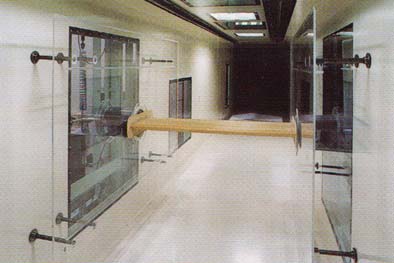
This full-span wind tunnel is one of the largest in Japan designed for full-span model experiments, with a total width of 16 meters. Full-span elastic model experiments of Rainbow Bridge (Tokyo), Akashi Kaikyo Bridge and other representative long-span bridges in Japan are conducted here. It has also been used for experiments involving power transmission lines and telecommunication cables. This image captures the wind tunnel testing configuration for Akashi Kaikyo Bridge.
Strong wind simulator
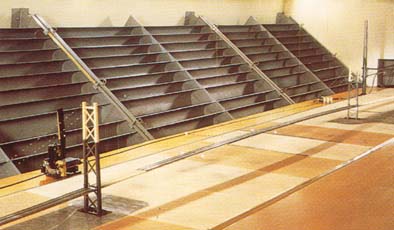
This boundary-layer wind tunnel is capable of accommodating wind speeds up to 30 m/s and has been designed with considerations for noise reduction. It supports both wind resistance testing and aerodynamic noise experiments. The photograph shows the experimental setup for a two-dimensional bridge model and a cylindrical specimen.
Experiment and measure equipments
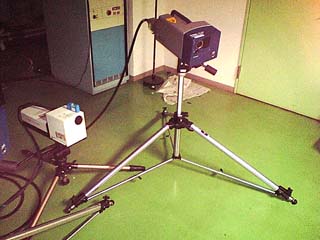
Lazer Doppler Vibrometer
The laser Doppler vibrometer utilizes the Doppler effect of laser light to detect the velocity and displacement of vibrations at the irradiated point. As it does not require physical contact with the specimen, it enables high-precision and non-contact measurements. Depending on the model, it offers functionalities such as long-range measurement, multi-point scanning, and measurement without surface preparation. These features make it a practical instrument for structural health monitoring and dynamic property evaluation.
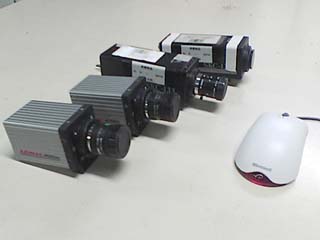
CCD Camera
These high-precision cameras are used to measure strain in components exhibiting large deformations, such as rubber bearings, and to detect surface cracks in structures and pavement. Efforts have also been devoted to the development of algorithms for analyzing the acquired image data.
Actuator
This equipment has a mass of approximately 50 kg and a vibration force of 50 kgf. By replacing the attached fixtures, it can be used with both horizontal and vertical vibration testing devices as well as exciters.

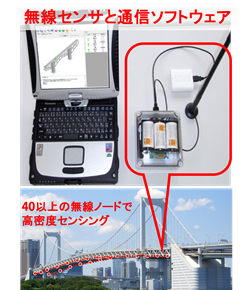
Wireless Accelerometer
The wireless accelerometer supports multi-hop communication with time synchronization accuracy on the order of several tens of microseconds, as well as high-speed data transmission. As it operates on battery power and requires no wiring, the use of such wireless sensors is expected to enable cost-effective and efficient evaluation of seismic and wind-resistant bridge designs, as well as the investigation of dynamic characteristics in large-scale structures.
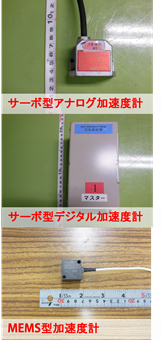
Accelerometer
The Accelerometer is used to measure structural dynamic responses. Servo-type accelerometers offer high precision and are capable of capturing ambient micro-vibrations even in the absence of external forces such as strong winds or seismic activity, thereby enabling identification of the inherent dynamic characteristics of structures. Additionally, the use of digital accelerometers—designed for improved convenience and simplicity—and compact, portable MEMS-type accelerometers has facilitated detailed monitoring of the behavior of structures, auxiliary components and vehicles.
Parallel Computer
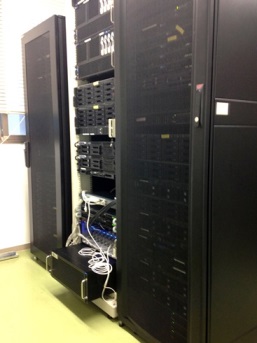
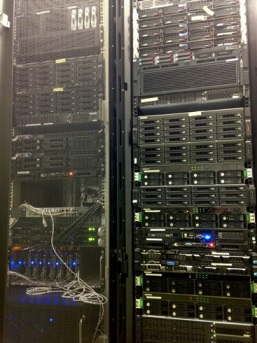
To support computationally intensive analyses such as numerical fluid dynamics simulations, our laboratory is equipped with multiple parallel computing systems capable of up to 160-core parallel processing. In addition, we also operate a real-time forecasting system for wind conditions and wind power generation.